
Pandemic Preparedness
Epidemic outbreaks can cause enormous health, economic, and political disruption. Ideally, we would prevent such crises by learning from past outbreaks and translating those lessons into stronger policies and institutions. This is especially important in China, as the country is considered a hotspot for zoonotic diseases due to its large and dense population, and close interactions between people, birds, and pigs.
To better understand how China responds to epidemic outbreaks, I have conducted several studies that analyze how crises influence policy, what kinds of reforms follow, and how lessons from past emergencies are—or sometimes aren’t—institutionalized. In doing so, I connect these developments to broader questions in policy process research, such as how problems gain attention, how political leaders frame crises, and how policy change unfolds over time.
Project 1: China’s Response to Risks from Live Poultry Sales
Live poultry sales in food markets is a key issue in epidemic prevention. Drawing on Chinese policy documents, news articles, World Health Organization data, and secondary literature, I showed that, as of 2023, a permanent nationwide ban was not adopted, despite the public health risks and strong political support. The main reasons for this are that such a ban is technically difficult, financially costly, and inconsistent with existing norms and values. The project deepens our understanding of how public policy comes about in China by using the multiple streams framework, which provides a systematic way of analyzing China’s authoritarian political system. The article also identifies priority areas for future MSF research in authoritarian contexts. This project has been published in the Policy Studies Journal (2023), click here to read the full-text pdf. Click here to receive a full-text copy.

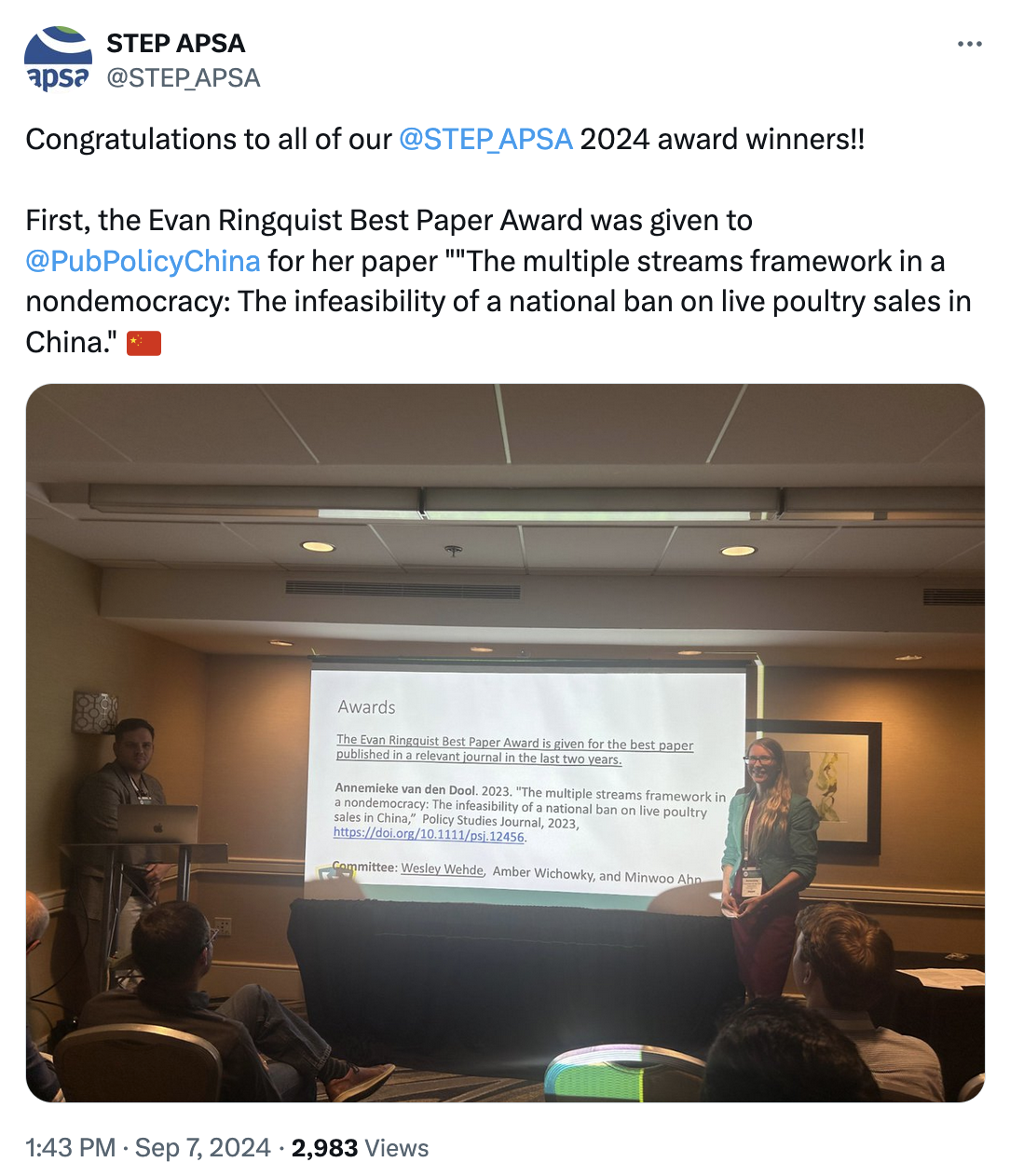
This article has been awarded the 2024 American Political Science Association STEP Evan Ringquist Best Paper Award, which recognizes “the best paper published in a relevant journal in the last two years.” I discuss the project in this interview with the DKU Center for the Study of Contemporary China.
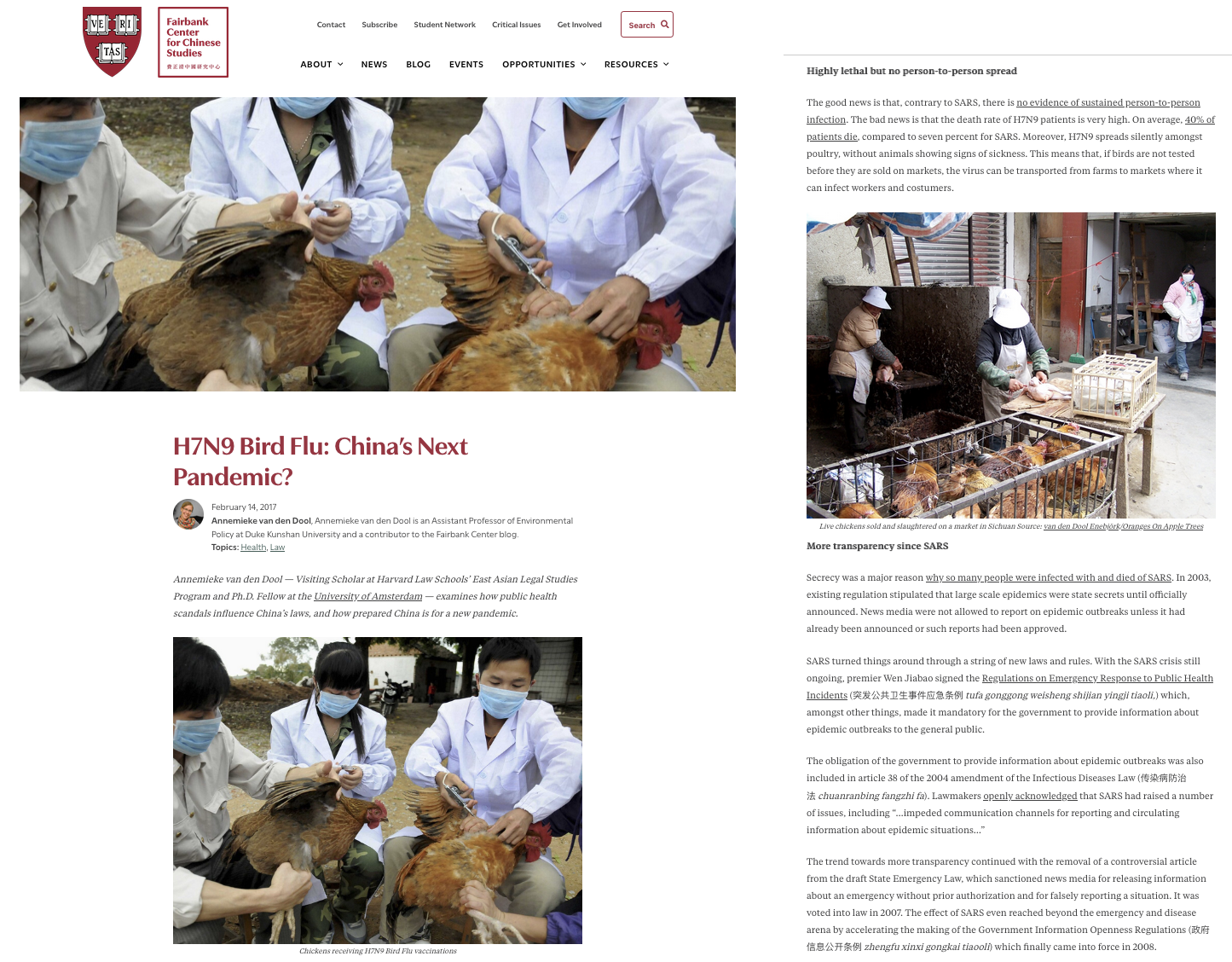
I first started to work on this topic as visiting scholar at East Asian Legal Studies at Harvard Law School in 2017, which coincided with a US CDC travel warning to China due to H7N9 avian influenza. See my blog post for the Harvard Fairbank Center for Chinese Studies here.
Project 2: China’s Infectious Diseases Prevention and Treatment Law
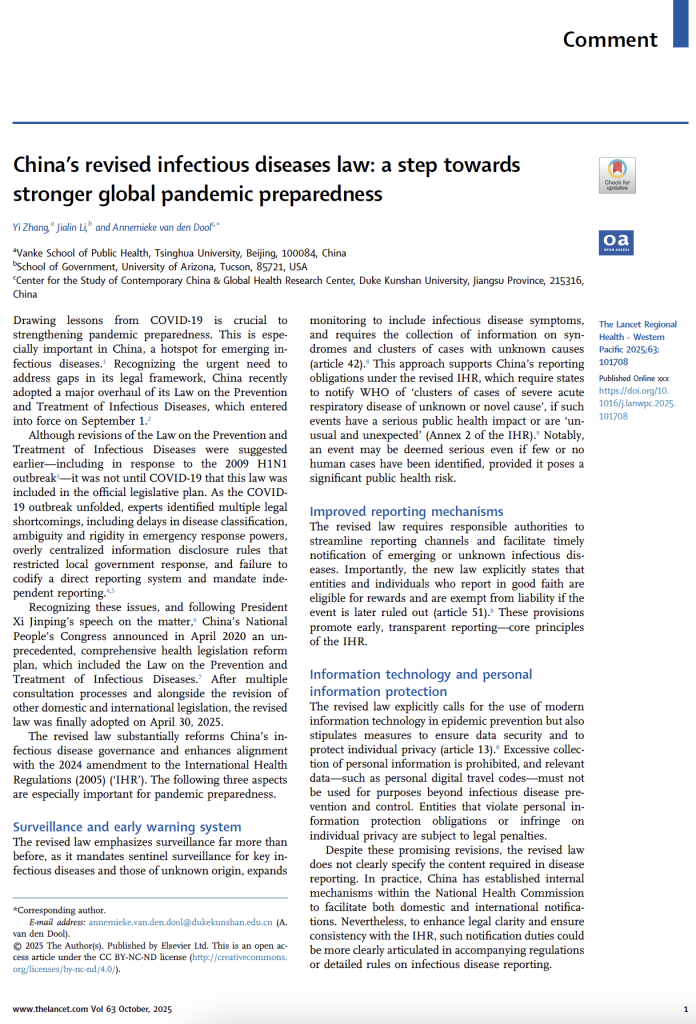
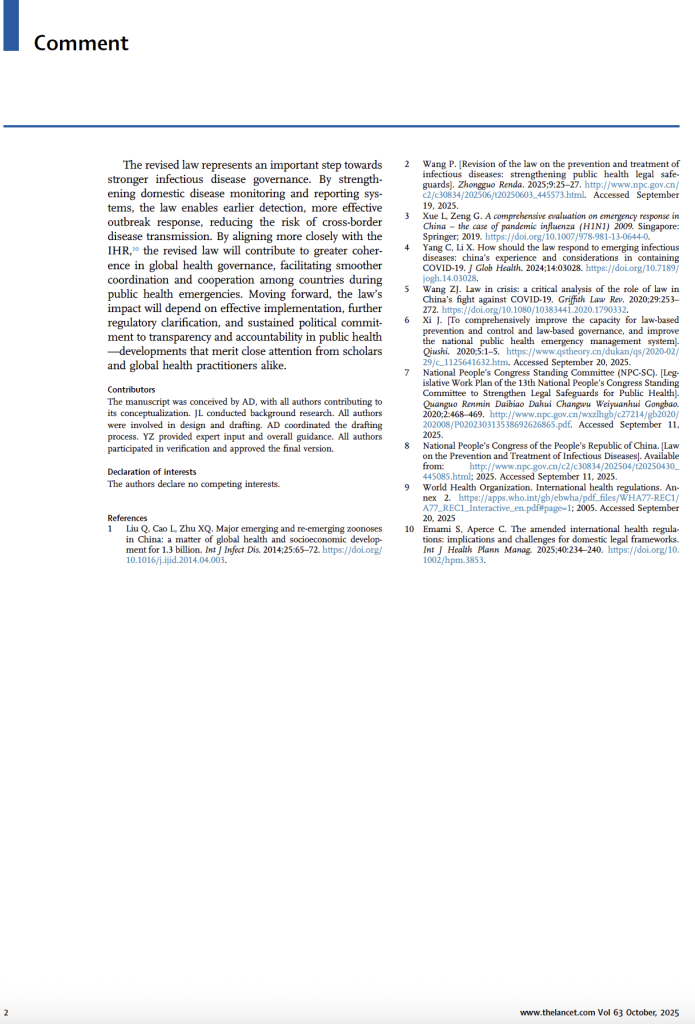
I have analyzed China’s Infectious Diseases Prevention and Treatment Law, which has led to several publications. This book chapter shows how the 2002-2003 SARS outbreak contributed to the law’s 2004 revision. This article shows how post-SARS policy reform was framed by policymakers in China. More recently, I wrote a comment article about the 2025 revision of this law following the COVID-19 pandemic, see here and below.
My research on pandemic preparedness has been supported by a China-U.S. Scholars Program Travel Grant generously provided by Carnegie Corporation of New York, Harvard-Yenching Institute, Henry Luce Foundation and Rockefeller Brothers Fund.
Project 3: Crisis-Framing by Public Leaders in China
(with Yihong Liu at Renmin University)
Existing research shows that post-crisis policy change in democracies is shaped by how crises are framed. Given structural political differences, it is unclear what role such framing plays in post-crisis policy change in authoritarian systems. This study adjusts the concept of crisis framing to authoritarian China and subsequently applies it to SARS, the Sichuan earthquake, and the H1N1 pandemic. The article shows that even though there are no competing frames, leaders in China do frame crises in different ways. We argue that if public leaders want to legitimate major post-crisis policy change, they simultaneously acknowledge the crisis, admit a malfunctioning status quo, and put forward explicit proposals for policy change.
Click here to read about my other research projects on policy processes in China.